
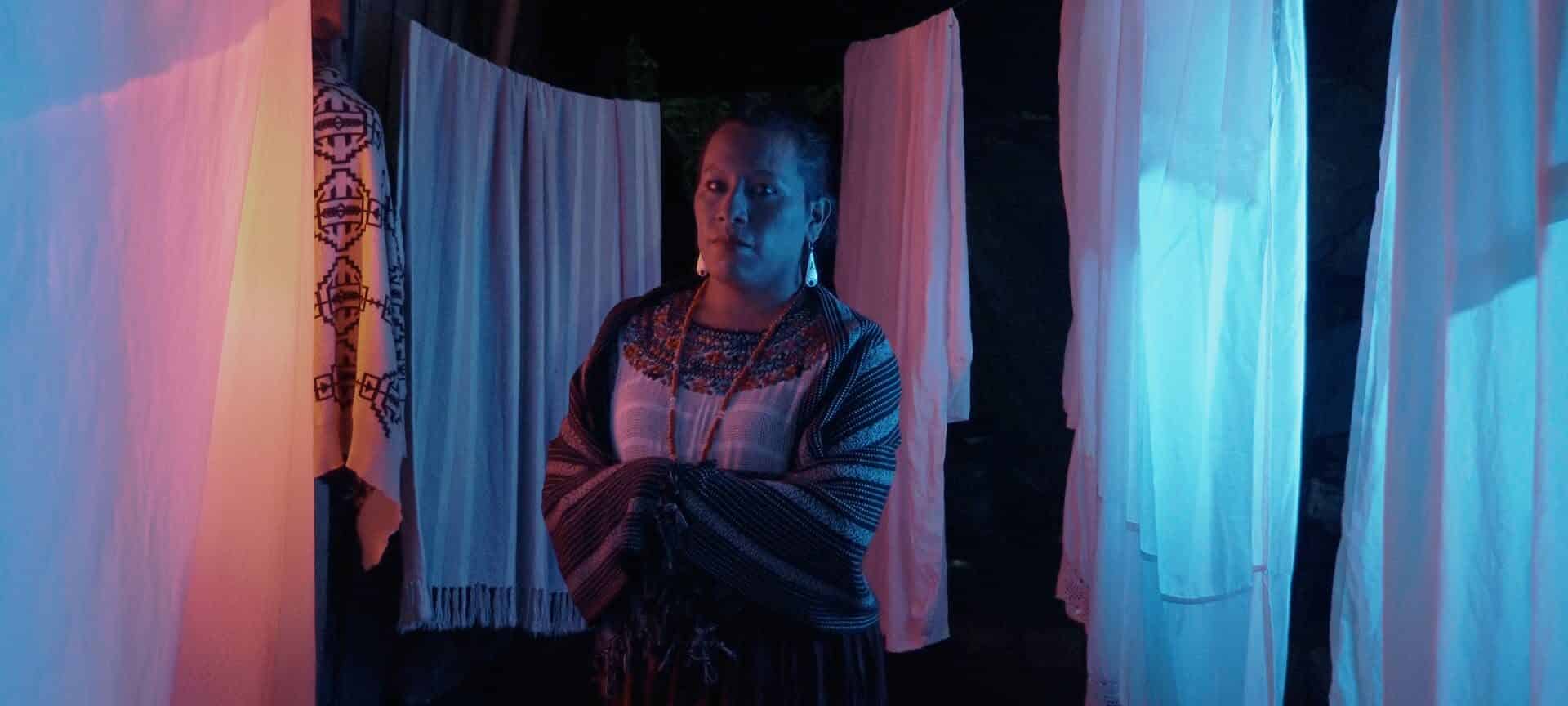
With June marking both Pride Month and National Indigenous History Month, I thought the perfect way to celebrate would be to catch some LGBTQ+ Indigenous shorts at the 2026 imagiNATIVE Film and Media Arts Festival. The Love Has No Gender shorts program was free to attend on Friday, June 5th at TIFF Lightbox as part of their TD Free Friday. Consisting of five short films from all over the world, The Love Has No Gender shorts program brought together an exciting and eclectic mix of stories.
IXIM: El amor no tiene género (2024) – dir. Alex PV
IXIM: El amor no tiene género (“love has no gender”), the namesake of the program, started off the event. The 30-minute documentary follows Monica, a Mayan Q’eqchi trans woman, exploring her journey and struggles in Guatemala. The documentary is framed from the filmmaker’s perspective as Monica shares her story with him and with the viewer. The film takes us into Monica’s world. We meet her family and hear about her day-to-day life.
A moment that stuck with me is when Monica talks about the discrimination she faces for wearing Mayan clothing or speaking Mayan-Q’eqchi-influenced Spanish. Her mother’s interview was also particularly memorable and heartwarming. Her concern for her daughter’s safety, embrace of her, and love in the face of discrimination from their community was touching. My only issue with the film is that the subtitles were not timed correctly, they were either on screen for too long or disappeared too quickly, making it feel like not all of the Spanish dialogue was caught.
Ata Pūao (2025) – dir. Allie Howell
Ata Pūao follows Hiwa (Luka Wolfgram), a young Māori trans woman who just moved to a new city with some friends that she has clearly outgrown. As we move through what is supposed to be a great birthday night out with close friends, it becomes clear that Hiwa’s safety is not a priority for them. As Hiwa meets other queer and trans people at the nightclub, she realizes that they are the family she has been looking for.
Hiwa is a likable protagonist who left me feeling charmed. Wolfgram did a great job of showing the fear and uncertainty that Hiwa experienced throughout the night. There is a moment at the start of the film in which Hiwa is left alone outside of a convenience store and is approached by an aggressive man. After she rejects his proposition, he threatens her with violence. Wolfgram really nailed the tone of this scene. I think that the film ends with just the right amount of feel-good found family cheesiness to balance out all of the negativity in the first half.
Host (2024) – dir. Zachery Cameron Longboy
This experimental short coming from multidisciplinary artist Zachery Cameron Longboy was a look into his own sickness and infection, as the artist himself leads these infections to the water in ceremony. The film acts as an art piece and a personal reflection on living with these conditions including HIV, Parkinson’s, spinal stenosis, and bedbugs.
I really enjoyed the way that the film was cut together. A lot of image and video elements were blended together with crossfades and overlays which not only looked cool, but demonstrated the way these infections coincide. The mix of cellular imagery and bedbugs has stuck with me.
O Alofa Nei, O Alofa Nā (2025) – dir. Giselle Ilaoa
Like Ata Pūao, O Alofa Nei, O Alofa Nā (“Love Me, Love You”) is a feel-good short from New Zealand about overcoming barriers. This film follows Manaia (Josephine Mavaega) as she battles her internalized homophobia when she reconnects with her first love.
While I enjoyed the cute sapphic love story between Manaia and Ata (Tahla Krösschell), Mavaega didn’t do the best job of portraying Manaia’s inner turmoil and fear. The emotional centre of the film rests on Mavaega’s shoulders as the only conflict is Manaia’s internal fight. Mavaega’s facial expressions seemed to default to worry, causing her character’s eventual self-acceptance to fall flat.
Gâteau Girl (Pussy Pussy Pussy) (2024) – dir. Shanelle St. Hilaire
Capping off the program, this 1-minute short was a pleasant surprise. This experimental short featured no dialogue with only one person on screen. They sit in front of a cake then proceed to finger it, then claw into it unable to resist. I really enjoyed the absurdity of Gâteau Girl, especially in juxtaposition to some of the longer, more serious or dramatic films. Gâteau Girl was like a breath of fresh air at the end of the program.
Author: