
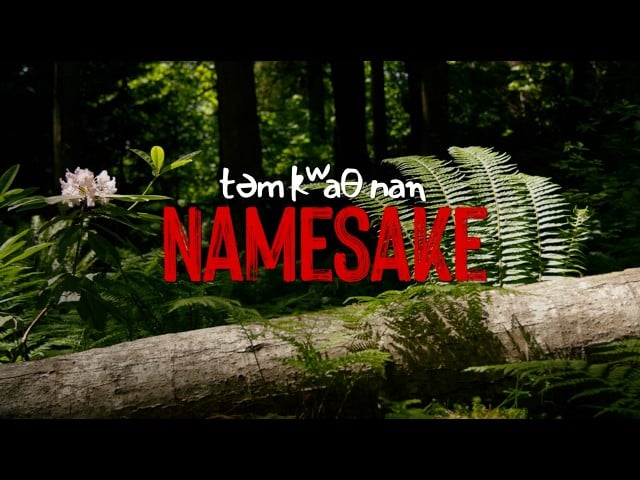
təm kʷaθ nan Namesake asks a central question: what is in a name? The film focuses on the Tla’amin Nation in British Columbia, where names carry deep meaning—rooted in language, land, and water. For the Tla’amin people, naming is not just descriptive; it is a foundational part of cultural identity and connection to place.
Directed by Evan Adams and Eileen Francis, this 76-minute Canadian Indigenous documentary, which premiered at TIFF Lightbox on April 29 and 30 as part of the Canadian Spectrum Competition, documents the ongoing debate surrounding this request. Through animated Tla’amin oral storytelling, observational footage of heated community meetings, and interviews with people on both sides, the film presents a complex and thought-provoking discussion.
In May 2021, the Tla’amin Nation formally asked the city council of Powell River—named after Israel Wood Powell, the Superintendent of Indian Affairs for British Columbia and a key architect of residential schools—to consider changing the city’s name. Powell also enforced the ban on the Potlatch, a vital ceremonial practice among Indigenous communities. For many, the name “Powell River” represents a history of colonial violence and cultural erasure. This request puts the city and its residents’ commitment to reconciliation to the test. The audience quickly discovers that there is a deep connection between language and place for the Tla’amin people. The name “Powell River” signifies more than just historical significance; it represents a lasting wound. Israel Wood Powell’s role in enforcing policies that stripped Indigenous communities of their ceremonial practices has ongoing effects on future generations. In this context, renaming serves as a way to reclaim identity, land, and cultural memory.
At the same time, the documentary does not present the issue as one-sided. By including voices from residents who oppose the name change, the film acknowledges the emotional attachment many have to the city’s current identity. Some argue that Powell contributed positively through education and public health initiatives, while others believe the city would not exist without his influence. These perspectives highlight the tension between historical accountability and personal connection. Additionally, colonization often begins with the act of naming. Assigning names to places serves as a method to claim and reshape the land. This concept is supported by both historical and contemporary examples, such as the way Powell River has been promoted as a scenic retreat. The discrepancy between its marketed image and its historical reality highlights the fact that public representations are often selective. The documentary is effective in its storytelling approach. The incorporation of animation to visualize Tla’amin oral histories prominently showcases cultural knowledge in an engaging manner. The sound design and musical elements effectively complement the narrative, while the narration provides essential context and depth. However, several sequences exhibit a degree of repetition, and certain moments extend longer than necessary, which negatively impacts the overall pacing of the film.
təm kʷaθ nan Namesake brings together interviews from both the Tla’amin Nation and the broader community, ensuring that opposing viewpoints are acknowledged rather than dismissed. It fosters dialogue, illustrating that the discussion about renaming is not just about selecting a new name; it is also about addressing historical grievances and redefining our relationships with the land.
Ultimately, the documentary portrays a community undergoing transformation. It illustrates that reconciliation is a challenging process and that genuine progress often involves discomfort. However, it is a crucial path for truly moving forward.
The film təm kʷaθ nan Namesake is available for viewing at the following link: https://namesake.film/.
Support for the Tla’amin Nation can be found at this website: https://www.tlaaminnation.com/documentary-feature-t%C9%99m-kʷaθ-nan-namesake-heads-to-hot-docs-taking-local-story-to-world-stage/.
Author: