
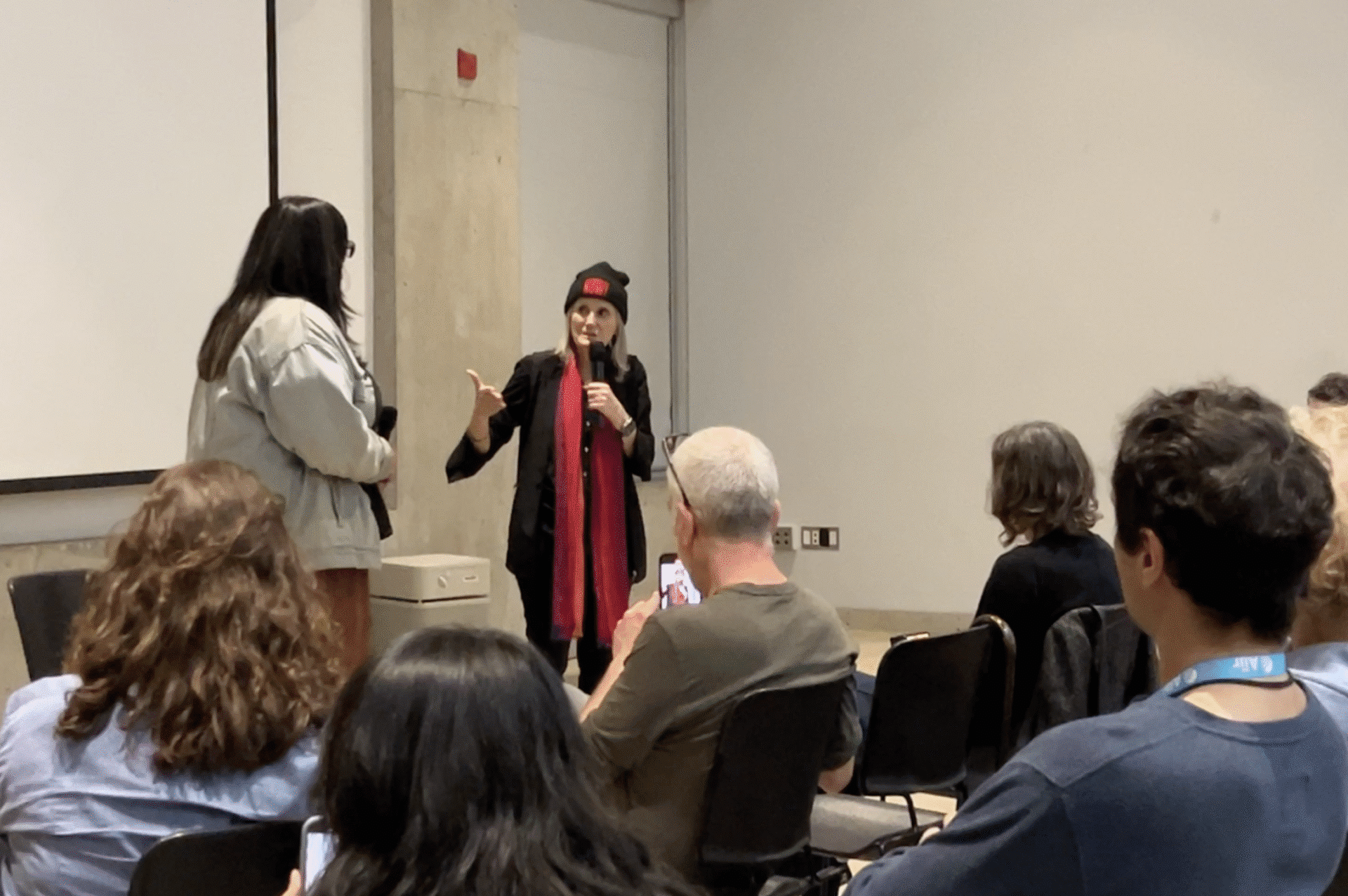
I had about 10 minutes to prepare for a live interview with Amy Goodman, in front of a room full of radio broadcasters. As someone who hears Goodman’s voice more often than my own mother’s, and has worked in independent media for nearly four years, the stakes couldn’t have been higher.
The longtime host of Democracy Now! has made a career out of asking questions that people in power would rather not answer. For decades, she has reported on war, political violence, and stories that fall through the cracks of corporate-owned media. Now, her storied career is chronicled in Steal This Story, Please!, a documentary by Oscar-nominated filmmakers Tia Lessin and Carl Deal.
I caught up with Goodman on May 4, the day after World Press Freedom Day, at Toronto Metropolitan University’s Student Campus Centre, where the film was screening for the first time in a grassroots, community-centred setting. She generously gave me 40 minutes of her evening to discuss the future of independent media, the problem with calling it “alternative,” the privileges of reporting as a Western journalist, what it takes to earn the trust of sources whose lives may be at stake when they speak to the press, and, as she puts it at the end of every broadcast, a whole lot more.
[Update: Nov. 10, 2026] Steal This Story Please! is now available for digital streaming.
KZ: This was the first grassroots screening of Steal This Story, Please!. Why was it important to show it in a community space like this?
AG: We couldn’t afford the cost of sending the show on satellite so we posted it online. And because we did that, radio stations could take it. We had nine stations to begin with at first, and then it grew and grew after the first year — to September 11, 2001, the horror of the terror attacks in New York. We were the closest national broadcast to Ground Zero.
A public access TV station asked to run us, and then hundreds of public access stations and PBS stations and NPR stations, more college and community stations, in addition to Pacifica Radio.
I should say, the history of Pacifica is very important. It was founded in [1946] in the Bay Area in Berkeley, California, by a war resister named Lewis Hill. He came out of the detention camps and said, “There has to be a media outlet that’s not run by corporations that profit from war, but run by journalists and artists.” And that’s how Pacifica was born. Not run by corporations, as the late dean of the Annenberg School for Communication would say, not run by corporations that have nothing to tell and everything to sell that are raising our children today.
Pacifica was born — Berkeley, Los Angeles, my station, WBAI in New York — it’s where you could hear James Baldwin debate Malcolm X over the effectiveness of nonviolent civil disobedience. WPFW went on the air in 1977. We were there this past weekend, we just held a fundraiser for them in Washington.
I told this to a group earlier today, that when we came to Baltimore, to the Charles Theater, there were a couple of films playing — The Devil Wears Prada 2 and Steal This Story, Please!. So as we drove up, the place was just bursting with people, lines out the doors, [attendees] going, “Oh, my god… like, no one’s going to be at Steal This Story and everyone’s going to be at The Devil Wears Prada.” As I came in, people started saying, “Thank you for Democracy Now!,” and I was saying, “Oh, that’s so interesting that you know Democracy Now! and you are going to see The Devil Wears Prada.” And so they said, “What do you mean The Devil Wears Prada? We’re going to see your documentary!”
So then I looked up and the sign said: STEAL THIS STORY, PLEASE! SOLD OUT. But you could still get tickets to The Devil Wears Prada 2.
I think there is a hunger for independent voices right now. I mean, when you look down on us, — in every sense of the word, probably at this point — but when you look south and you see what the United States is going through, it’s very serious.
Reporters Without Borders just came out with their rating of freedom of the press. I think the United States is around 64 — a third of the countries are better than the most powerful country on Earth. And it must be rapidly descending from that.
Just this weekend, President Donald Trump threatened saying anyone who says the U.S. is losing the war in Iran is guilty of treason.
Not that he respects the courts or follows any edicts if we were to go to court, but we already know he calls us the enemy of the people. Of course, nothing could be further from the truth, but so much of what President Trump says couldn’t be further from the truth.
Freedom of the press is essential to the functioning of a democratic society. There’s a reason why freedom of the press is enshrined in the U.S. Constitution, the First Amendment. And the flip side of that is the public’s right to know. How do you have a meaningful democracy if you don’t have information that you can trust? And that’s what we’re about at Democracy Now! So we went from nine stations in 1996 to 1,500 stations today, with headlines translated to Spanish too. It matters so much that we have accurate and fair information that people can turn to.
KZ: Speaking of independent media, in the film and in broader discourse, it’s often framed as “alternative” media. But for many communities, as is shown in the film, it can be the only place where their stories are told. Do you see this work as alternative or essential?
AG: I see it as independent, and it’s a very good question. In the same way I don’t call ‘corporate media’ ‘mainstream media.’ I don’t think it’s mainstream, right? I really do think that those who care about war and peace, the climate catastrophe, the fate of the planet, LGBTQ+ issues, racial and economic justice, the immigrant crackdown in the United States, those who care about equality are not a fringe minority. Not even a silent majority, but the silenced majority — silenced by the corporate media. Which is why we have to take the media back. We have to both challenge their narrative and also build our own media.
We see legacy media consolidating. So many journalists are losing their jobs. And by the way, last night I was on MS NOW (that’s the new name for MSNBC) to talk about the film and the state of the media today. It was World Press Freedom Day yesterday. So I’m talking to people in the corporate media, but I have a lot of respect for many of them. They go into that media for the same reasons that many people in independent media do. They want to challenge those in power, and they want the broadest possible platform to do it. The problem is, can they do it there?
I often talk about the access of evil. That’s trading truth for access. You see when I go to the White House, I am a little relentless in my questioning because I don’t think it’s worth trading truth for. If you ask a few softball questions, they might call on you the next day. Then what’s that answer worth? We need politicians more than politicians need journalists.
KZ: Your work often centres people who are directly affected by the issues you cover. How do you build trust with sources who have every reason to distrust the media, particularly those for whom speaking to reporters can carry the risk of death, as it did for Ken Saro-Wiwa?
AG: Like community media here, we show up and we’ve been doing that for years, for decades. People see our role as going to where the silence is, to cover people in prison and to cover those behind the bars, those on death row, to cover what’s happening on the ground. As you can see with the standoff at Standing Rock in North Dakota, it often isn’t silent. It’s raucous, it’s rowdy. People are organizing. It couldn’t be louder. But it doesn’t hit the corporate media radar screen. That’s where we live.
Now, the corporate media is going through a series of consolidations that are terrifying for everyone because it means there are fewer and fewer platforms for people’s voices to be heard. It’s also why we have to build this independent model all over.
Look at The Washington Post. Tonight is the Met Gala in New York, by the way. I live in New York, down the street from the Met, but I must admit I’ve never been there. It’s pretty loud tonight, the protests outside, because the Met Gala is being brought to you by Jeff Bezos. Jeff Bezos, who just laid off a third of the journalists at the Washington Post. He bought it over a decade ago, and people were very concerned, “What is the billionaire founder of Amazon gonna do with this paper of record?” Within a few years, they developed the slogan, “Democracy dies in darkness,” which is a very good slogan. Well, it’s very dark at the Washington Post right now.
A few weeks ago, hundreds of journalists were laid off. We had in our studio a Washington Post reporter who did an analysis of the first day of the U.S.-Israeli attack on Iran, particularly southern Iran, at the primary girls’ school. At least 175 people were killed, about a dozen teachers, but overwhelmingly, little girls going to school. It looks like it was a U.S. Patriot missile. Trump immediately tried to say it was Iran. But [Nilo Tabrizy] did this incredible analysis of this whole strike and how it happened. She wasn’t reporting for the Washington Post anymore ’cause she had just been laid off days before.
The reporter on the frontlines for the Washington Post in Ukraine got the message: “You’re no longer working for the Washington Post.” And yet, Jeff Bezos paid Amazon $40 million right about the same time for the Melania [Trump] documentary, and $135 million in addition for publicity. Now, Amazon is talking about reviving The Apprentice — that’s how President Trump came to be known, that reality TV show. It will star Donald Trump Jr. So you think about the kind of favour that is being curried. They pay an exorbitant amount of money for the documentary, which is just to give money to the Trumps. They slice and dice the Washington Post staff, and then they provide a platform for the next generation of Trumps. That’s not the role of a media serving a democratic society. That is going down a path of authoritarianism, the state and the press merging that is completely unacceptable and very dangerous.
You’ve seen Maria Ressa, the Nobel Peace Prize-winning journalist, say, “The rights you lose today, you may never get back.” This is an ominous warning. But the fact that you’re all here, and most of you are involved in community media or public media somehow, is so important. I really think that’s the hope.
KZ: There’s this subtle story of privilege throughout the film. Because of your status as a Western journalist, you were able to gain access into the Chevron facility in Nigeria by waving around your American passport. But then on the other hand, in East Timor, you were attacked precisely because of your identity as a Western journalist. Could you speak to how you address power and positionality when reporting in, or about, the Global South?
AG: These are all excellent questions. In East Timor, we walked to the front of the crowd. We knew the military had committed many massacres in the past that killed a third of the population of East Timor.
Ultimately, the people of East Timor would become free because of the UN-sponsored referendum for them to choose whether they wanted to be part of Indonesia or free. In 1998, about eight years after the massacre where they killed 270 Timorese, they voted overwhelmingly for their freedom as the Indonesian army burned East Timor to the ground and killed another 1,000 Timorese. In 2002, they would become one of the newest nations in the world.
But when we were there, November 12, 1991, thousands of Timorese had marched to the cemetery to honour the dead, and the Indonesian soldiers marched up 10 to 12 abreast carrying their US M16s at the ready position, we walked to the front of the crowd (me and my colleague, Alan Nairn, who was writing for The New Yorker magazine at the time). Because although we knew they’d committed many massacres, they’d never done it in front of Western journalists. We thought maybe just our presence would head off the attack.
So I held my microphone up like a flag, slung my tape recorder over my shoulder, Alan put the camera above his head, and we walked forward. The soldiers marched up. They swept past us without hesitation, without warning, without provocation. They opened fire in the crowd, gunning people down from right to left.
The video you saw [in the film] was inside the cemetery. That was people going through the one gate in that cemetery wall and running as fast as they could. We were standing in the road. That’s where everyone was, hemmed in by the walls of the cemetery and on their side, and that’s where they opened fire. Some were able to escape there.
We were right at the front and they were shouting at me and Alan, “Australia. Australia. Are you from Australia?” And we knew what that meant because when Indonesia invaded East Timor, a month or two before, in 1975, there were five [Commonwealth] journalists covering the lead-up to the invasion. They caught them in a town called Balibo (there’s a very good movie called Balibo). They lined them up against a house and they executed them. [Two were Australian] and the Australian Broadcasting Corporation and the Australian government hardly protested the killing of their journalists. We believe because Australia and Indonesia would later share the spoils of the Timor Gap. Oil is the source of so much pain in the world.
So as they shouted “Australia” at us, we knew exactly what they meant. They understood if we were from Australia, there probably wouldn’t be a problem with killing us. But we shouted, “We’re from America, America.” They’d stripped us of everything at that point. The only thing I had left in my skirt, in my pocket, was my passport. They’d stripped down everything. And I shouted, “America, America.”
They had already beat me to the ground, Alan on top of me. You saw how he was covered in blood as they used their US M16s like baseball bats, and they slammed them against his head until they fractured his skull. And then they put the guns to our heads and fired in squad fashion and kept shouting, “America, America.” We were from the same country their weapons were from. They would have to pay a price for killing us that they never had to pay for killing the Timorese.
They moved on, a Red Cross Jeep pulled up and we were able to get into it. Dozens of Timorese jumped on top of us, on top of the vehicle, just to escape this killing ground. And we drove that way to the hospital. At the hospital, the doctors and nurses started to cry when they saw us, not because we were in worse shape than the Timorese. We weren’t. They killed more than 270 Timorese on that day.
But they see us Americans, and not just Americans, they see all people in the West in two ways. They see us as the sword and the shield. The sword in the case of America, and I think with Canada as well. We were from the country that was providing the weapons. Canada did also, Britain did also. But they also see the people as the shield, and they saw that shield bloody that day. That just increased their despair. We clearly had not stopped the massacre and we knew the only way at that point that we could would be to get out and to tell the world what had happened. It could only come from pressure from the outside world.
We made our way to Bishop Belo’s house in Dili. He would later win a Nobel Peace Prize. Bishop Belo helped me clean up Alan. You saw how bloody he was. I took off that shirt, put on another shirt and I took Alan’s shirt. I wrapped it around my waist under a towel that Bishop Belo gave me to hide it. But they absolutely denied that this had happened, which of course we expected. Then, well, what’s with this bloody shirt if I could get out of the country? That’s what I would say.
We made our way to the airport. We said we had to leave, and we didn’t know if it was because they’d already made a decision not to kill us and now they just wanted us out or what it was. But there was one plane out that day. And Alan said, “We have to get some medicine for her.” For me. We had cleaned him up, but now the blood was again coming down. It was trickling down his neck. And he felt it was more important to distract attention away from him, you know, that we weren’t from the massacre site. I just needed to get some medicine, and we would be back soon.
We couldn’t go back to the hotel. We couldn’t get our things, nothing like that. They’d already raided the whole place. So we got on the plane, we walked onto the tarmac. The military was escorting us and Alan was having electric shocks through his whole body, so I knew we had to slow down. And I just said, “I just wanna take one more look at this beautiful country.” When we got on the plane, the flight attendants gave me a silver bowl of water and said, “Clean him,” about Alan. We went from East Timor to West Timor, which is a part of Indonesia, and then we flew on to Bali, which is part of Indonesia. And there, we got onto, at the time, a Continental flight. Remember Continental Airlines? They didn’t want us to come on. They were trying to stop us from coming on. They said those were vacation-goers who were going back to other countries from Bali, a beautiful paradise on earth, and we would make them sick by just what we looked like. But we ultimately could get on, and we flew back to the United States.
When Alan got out of the hospital, it was just a few hours. Well, we flew on to Guam, which is a US territory, and there they sewed up Alan’s head. All the media was calling us at the hospital. The switchboard at the Guam Memorial Hospital was inundated, and we just kept saying to each outlet that called, “There was a massacre. There was a massacre. There was a massacre.” Then we moved on to Washington, held a news conference at the National Press Club and said the weapons they used were from the United States. When Indonesia invaded, 90 per cent of the weapons used were from the United States.
When Alan got out of the hospital, it was just a few hours. Well, we flew on to Guam, which is a US territory, and there they sewed up Alan’s head. All the media was calling us at the hospital. The switchboard at the Guam Memorial Hospital was inundated, and we just kept saying to each outlet that called, “There was a massacre. There was a massacre. There was a massacre.” Then we moved on to Washington, held a news conference at the National Press Club and said the weapons they used were from the United States. When Indonesia invaded, 90 per cent of the weapons used were from the United States.
17 years before, in 1975, a nationwide movement called the East Timor Action Network grew up in the United States, and there was one in Canada called the East Timor Alert Network — both called ETAN. And they put pressure on both governments to stop selling weapons to human rights-abusing regimes. And you, [in the film,] saw me questioning President Clinton, a Democratic president, because he was going to try to restore military training. The people of East Timor voted for their freedom, and ultimately, they are an independent nation today.
“They see us as the sword and the shield”
Amy Goodman
Author: