
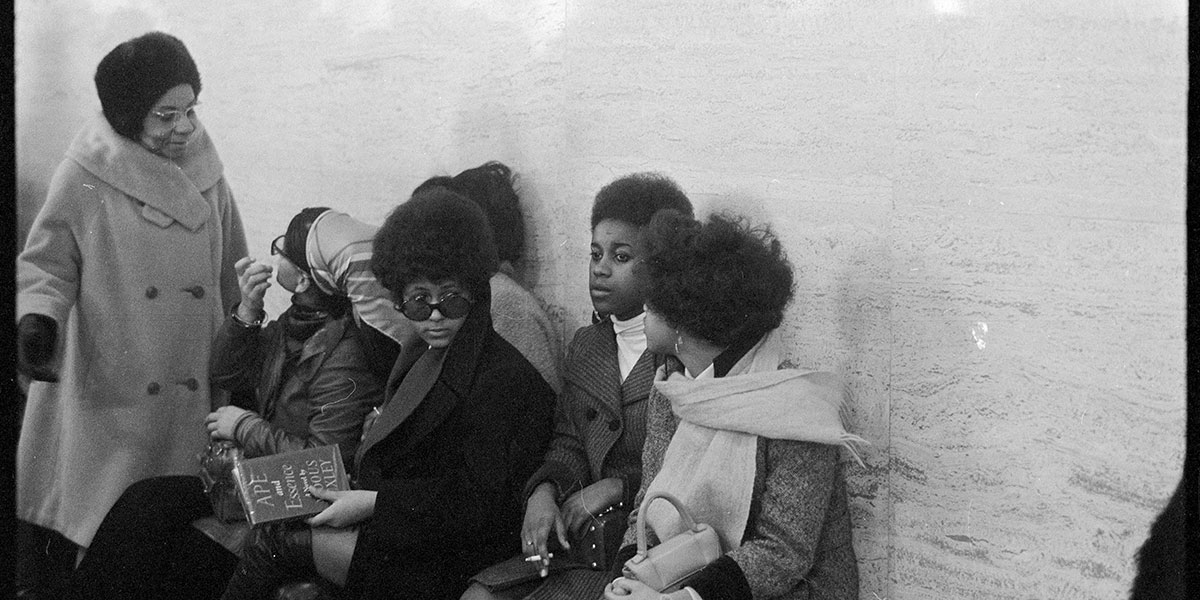
Every nation is built on stories. Some are preserved in textbooks, monuments and public consciousness. Others survive in fragments, carried by the people whose lives were shaped by them.
More than 50 years after hundreds of students occupied the computer centre at Montreal’s Sir George Williams University to protest anti-Black racism on campus, the uprising remains largely absent from Canadian collective memory. What began as a challenge to the racist actions of a biology professor became one of the largest student riots in Canadian history, and filmmaker Michèle Stephenson is refusing to let it be forgotten.
In True North, Stephenson returns to the occupation through the voices of the activists who organized it, including Brenda Dash, Philippe Fils-Aimé, Josette Élise Pierre-Louis, Norman Cook and Rodney John. The film situates the events of 1969 within broader histories of Black internationalism, anti-colonial struggle and Caribbean migration, tracing the connections between a Montreal campus and liberation movements unfolding across the globe.
The sit-in ended in a blaze after negotiations with the university collapsed. More than 90 people were arrested. Activists were surveilled, criminalized and, in one case, deported. For Stephenson, a former international human rights attorney with Haitian roots, the story became a way of understanding her own relationship to Canada as she uncovered unexpected links between the occupation and her family’s activist past.
Ahead of True North‘s screening at the Mayworks Festival of Working People and the Arts, Canada’s longest-running labour arts festival, Stephenson sat down with CJTM to discuss historical erasure, Canada’s colonial mythology, how liberation is a constant struggle and why power depends on keeping certain histories out of view.
This interview has been edited for length and clarity.
What do you think it says about this story, the 1969 student uprising, that it has been so consistently buried over time?
That’s a good question. I think it comes to being consistently buried, it has to do with the power of the myth of the Canadian narrative that we’ve, sort of, bought into while growing up, and how that sometimes self-perpetuates without very intentional pushback.
The settler-colonial narrative that we are fed requires consistent, intentional work against. And so because that’s such a huge hurdle, even when some films come out about these things or certain things shift, it’s almost like an elastic. You push back against the elastic, but once there’s no tension, it goes back to the way it was. So there’s this constant push and pull.
This is not the first film about the occupation. I do think it’s the first film where many of these people are interviewed on-camera, people who experienced and led the occupation. Narrative is something that’s very difficult in culture to shift. It requires this continuous pressure, and I hope this film is one of the building blocks that continues that.
It’s interesting… I was at Concordia back in February for the anniversary, and we were screening… in spite of the apology that happened in 2023, there is still a new wave of young people at the school, at the university or otherwise, who had still not heard about this moment of resistance.
I think it’s gonna require a lot more intentional work incorporating not just this moment, but I think all of the history of Black Canada into our collective consciousness. ‘Cause I grew up not knowing much of the history.
I went to college with Rosie Douglas’s daughter. She was my friend. Some of these people were actually friends of my parents, you know? But then even within the community, the discussion was not a consistent one. So it’s just easy to be erased when the larger narrative holds the power.
Who do you think benefits from not knowing this history?
Those who benefit are the ones who have the interest of keeping the status quo as it is, meaning, neoliberal, capitalist-interested people who want to exploit those who are marginalized so they can profit. So it’s people invested in the capitalist system, which requires this caste system in order to be able to extract profit.
This is from the inception of the country, right? I think Rosie Douglas mentions that in the clip from the talk show when we talk about Canada’s own history and coming to terms with that. The founding of the dominion is based on this level of extraction and violence, and the mythology builds itself in order to keep the interest of those powers continued.
Let me explain, in some ways for me personally, how that plays out. The understanding that knowing your history becomes a source of power for resistance — that’s what those who are invested in a continued capitalist extractive system understand as a threat. For me, growing up, there was this cognitive dissonance, between the mythology of Canada’s history of what I was learning and the experiences that I was having firsthand, in terms of the discrimination that I was suffering and witnessing with my parents, extended family and friends as well.
So you’re experiencing something that has no historical reference because it’s not taught to you. You don’t have the language, and so you feel alienated, isolated, very doubtful of your own sense of self and belonging. For me, that relationship with Canada was very taut, and it’s one of the reasons, maybe, I feel deep down, why I left.
I did not feel the connection, right? In spite of this Caribbean history and larger Black and brown history being fundamental — the resistance part, that thread, being fundamental. I mean the history of even slave revolts in Canada itself. When we talk about Angélique in Montreal and these other figures that we’re not aware of, or people involved in the civil rights movement.
So I left the country, many ways because I wasn’t feeling this sense of belonging. And then this film became a part of this healing process for me in terms of my own relationship to Canada, understanding the history, the level of the fact that I wasn’t alone, in not just my experience, but in the community and the history that existed.
It made my connection [to Canada] much more complicated. There was a healing process through knowing the history. So there is a reason why those in power have so much investment in keeping these certain narratives, mythologies alive. Because they know that once we question it, they have nothing to stand on.
I live in Brooklyn now.
I know that you were first approached with this story by Leslie Norville, who created a documentary series called Black Life: Untold Stories. What was your first impression when she came to you with this, and how was it working with her on True North?
Well, I was very, very excited. Leslie and I, we’ve known each other actually for many years. She was also sort of a transplant from Canada. She lived in Brooklyn at the time when she approached me. She actually asked me what episode I wanted to work on. I directed the Revolution Remix [episode]. And I often say that the ancestors were calling me to work on this one, because of the less than six degrees of separation between the people involved and my own personal family circle. Working with Leslie was deeply transformative. She’s a producer who deeply respects the creative energy, the creative process, the creative vision of the directors that she works with, and I’m deeply grateful for that. And she certainly allowed me to take risks with the episode and with the feature.
She didn’t hesitate to accept the decision to do the film all black and white, and the decision to keep the 4×3 dimension, using the film effect. We didn’t shoot on film, but we ended up putting a 16 millimeter filter on the interviews so that it would be seamless with the rest of the film, and people would be completely immersed in this archival experience and not be allowed to remove themselves from the moment. It was truly a transformative experience for me. We were so blown away by all of the material that we were confronted with, both archival and the stories, some of whom we really couldn’t do justice to in 45 minutes.
We decided to embark on this feature-length film that, while inspired by the 45 minute Revolution Remix, is definitely its own thing, its own sort of world, its own aesthetic.
Speaking about the form, I know that you’ve said that the “political isn’t just in the content, but it’s also in the form.” Can you expand on that and talk about how these choices around structure, editing and the use of archival material can become political, or politicized, in a film like this?
For me, in my practice, as you said, it’s very important to centre the fact that form is also political. And what I mean by that is that it’s important to challenge the inherited and sometimes Western-oriented storytelling conventions that certainly documentary film falls into. Often nonfiction film centres victimization, centres in some cases poverty or disaster porn in that way, and doesn’t centre agency or resistance.
So how do you attack that from a form perspective? Well, you challenge the three-act structure, right? You challenge this linearity of storytelling. You give your participants or characters a greater complexity. And then we also importantly include joy, connection and community.
This film in particular, if you look at it, it’s more of an ensemble collective story. There’s not really one voice, one superhero or one protagonist who leads the story, whose journey we follow. This is a story of a collective journey, each with their own distinctive contribution and baggage that they bring. So this has become a mosaic, a conversation, a multilayered experience. I feel, on the one hand, that that sort of challenges a traditional approach.
The other thing that was very important is the use of archival — there are multiple ways we use archival material. One was to let certain archival pieces just speak for themselves, no commentary, right? No explanation. These were often news reels of back then in the day that challenge our notion of the way racialization was working at that time. And we’re confronted, I think, with a pretty stark reality of these white male reporters and their positionality, their assumptions, and their flattening of the people that they were engaging with.
I like to call it, like, the archival as verite itself, its own sort of observational moment. And it was in conversation with archival we found that that became a metaphor for us. It was metaphoric, not literal in any way, and we entered our participants’ minds, their interiority, through the use of archival.
For example, we have snow of different textures throughout the film that gives this sense of cold and what some of our participants were facing, and we played around with that. It was very important — when I talk about the joy aspect, it’s bringing in the archival elements of community. Whether it was the Negro Community Centre of Montreal, the engagement with Black magazines from the United States to create more community, or dance — which recurs [in the film] throughout club life, for people to understand that wherever there is oppression, there is always joy because we’re human beings.
We may suffer from elements of oppression, but it doesn’t mean that we also don’t find joy in our daily existence, or always work toward building community. So that was very important. And sometimes in the narrative, we take certain turns that are not necessarily classic, you know, three-act structure elements. For me, there’s this idea of circularity of storytelling, the spiral nature of history, of life, that we try to replicate in the actual edit as well. So things that we open the film with, we also end with. We play with time travel a little bit too.
It’s nice to be experimental and play, but it’s always important for me to be grounded in something that’s transformative and emotional and not too intellectual, right? ‘Cause sometimes we get esoteric sometimes and start, you know, a little bit navel-gazing in terms of thinking about the esoteric nature of cinema or that kind of thing, and it stays at a certain level. I think you can experiment and be accessible at the same time and not lose the emotion of the moment.
That joy most definitely is present throughout. I recall one of the last archival clips in the film showing students dancing during the occupation… Speaking of the news clips, you pull from print, TV, radio archives, and a lot of that material, as you mentioned, carries racial prejudice. How do you see the role of newsmedia in shaping public perception of racism and systemic inequities, from 1969 to today?
It’s a big question. It’s toxic today, it’s very toxic.
I even hesitate to name what we’re doing as counter-narratives, because that already puts us in a space of weakness once we put counter, you know? No, these are our narratives.
I like to define myself as an artist and someone who works in creative nonfiction, and challenge a lot of the assumptions of, quote-unquote journalism, which has sort of lost its appeal or its veneer of, quote-unquote, objectivity — which we all know was really code for maintaining a status quo.
What I learned through spending time with the media is its role in keeping the caste system the way it is, sometimes behind liberal jargon. What has happened with social media is that it has burst that bubble, but because of the algorithms and how those social media structures are constructed, the full agency that we could gain through these tentacles have not borne fruit at all. It’s sort of this greater sophistication through fragmentation of media through social media that we’re experiencing right now.
It’s interesting… We’re at BAM here in Brooklyn. There’s a short series coming up now in May around revolution in the digital age, and one of the films that’s being discussed is The Square, which is about the Arab Spring, in Egypt. When you think about these bursts of agency through social media that completely counter the status quo tendency of regular mainstream media are short-lived, and sometimes what the pushback is is even more oppression. In the late ’60s and early ’70s, there was a state-sponsored violent repression as a result of these revolutionary tendencies that were supported by mainstream media.
There were few narratives. They were successful, like with deporting Rosie Douglas, who was trying to do work of solidarity with First Nations communities and with Black communities across Canada, he was too dangerous. Today, the surveillance exists but it’s on our phone.
It’s become ingrained in the commercial for-profit model that exists through what some people call a new age of cloud capitalism and techno-feudalism that we’re experiencing. So it’s almost like we no longer even need mainstream media to keep us… I don’t wanna be all doomsday, but we have to think about how media that supports the status quo is manifesting itself in our lives, and what are the tactics that we must engage in to remove or push back against those influences?
In the film, at the end, Philippe Fils-Aimé in the film talks about how this is the constant struggle, and if you don’t struggle, then you die. This is why I talk about this idea of the spiral. It’s like there’s a lot of elements of déjà vu, but it’s not exactly the same. There are certain things that have shifted. Some of the tactics are the same, but the results are similar, or in some cases even worse. So how do we analyze this history that informs us, and understand what this new configuration looks like, and how do we combat it?
It may not be just occupying a campus or university. It may need other tactics as well. And I can’t answer that. It’s not quite my generation anymore. I was part of the anti-apartheid generation, the divestment. We were at McGill doing the protests and we’re at the tail-end of what was like a 40, 50-year history of resistance to get institutions to divest from South Africa. We continued as students, and I was young enough at the tail-end of that arc to see change.
The film itself is an archive of memory, as you’ve spoken about. I know that you’re working on making the full conversations with the activist elders publicly accessible someplace. Can you speak about where you’re at with that and why that was important for you to do?
At this point, there is an effort that Leslie has started to engage in to make the full interviews, unedited, accessible, and we’re hoping it happens through the national archives, but that is still at its very early stages. We’re a very small team, and we’re actually now just very focused on getting the film out and distributed throughout Canada and beyond. We’ve just brought on our educational and community screening distributor in Canada, Funambules from Montreal, and we’re working on a plan for a national tour with the film in the fall. So that’s the first step, you know, getting the film out there.
The film itself is an archive. I think some of this archive people have seen Some of this archive very few people have seen. But what is interesting, and what I try to work on in my practice when I use archive, is the understanding that our lens is a different lens of looking at the archive and what’s important and how we juxtapose it. So the meaning that comes out of the archive, the way we have laid it out, is very different, than if someone else were to take it because of our perspective and the intentionality behind it.
For example, women’s voices — this was a very, very difficult task for us, to find audio-visual material that included the Black women who were leaders in this struggle, because they were behind the camera. They were often not the ones picking up the mic, not the ones necessarily doing the speeches, or if they were making speeches, they were not the ones that were televised or recorded. But we know through text and through discussion with elders how important their contributions were, whether it’s Brenda Dash or Joan Jones, Rocky Jones’s ex-wife, Josette Pierre-Louis, other women who are in the Revolution Remix episode.
It was very important for us, and when we found this clip between Joan Jones and her daughter, Tracey Jones, not many people will recognize her but we knew that this was probably one of the few audio-visual material that we were able to find, and we knew that we didn’t care how or where, it was going to be in there as part of an archive of the film so people see it and hear and understand women’s voices in the movement.
The hope is, once the tour is over, once we’ve settled in our screening of the film, that we can really collaborate and figure out where we can house the full interviews. With someone like Norman Cook, it was an eight-hour interview, and there was so much that was left behind that really gives a greater understanding of Black life for his generation and his particular community and the background that he comes from in Toronto. But that being said, there was no one we spoke to for less than four hours. So these are all very, very rich materials that need to be part of the Canadian patrimony.
I really look forward to listening to all of the unedited interviews one day.
During your research for the film, you discovered that your own family members were involved in the protests at Sir George Williams Campus — can you take me back to that moment when you first learned that? Did this shift anything for you personally or as a filmmaker?
Well, there are two things I learned. First, I learned the depth of the militant involvement that my family, specifically my father and grandfather were involved in — resisting the Duvalier regime in Haiti and understanding the violent threat we were under that led us to the United States and then Canada.
I learned this from Philippe, who happened to be a neighbor of my family. I was a little baby when we left, so that really threw me because growing up with my family, there were discussions, but not the specific details certainly that Philippe shared with me. And my first instinct was to go to my mother, my father passed away, and just get all of that, like, “Is it true? Is this true? Is that true?” And she said, “Yes, that’s right. That’s true. That’s what happened.”
It revealed for me that particular story, one that I think has an embodied memory we carry that’s unconscious. I think that, if anything, there’s a reason behind the work my ancestors have done that have led me to do the work that I’m doing right now, even though I can’t sort of explain it.
There’s something that has been transmitted unconsciously, which is part of this embodied memory of resistance that is often not centred when we talk about history. History’s always about what’s written, right? I felt a little bit robbed, too, because I wish I had known some of this and was hopeful that my father had been around longer so I could talk to him about it.
And with regards to the family who were involved… I was just sitting with one of my cousins in Montreal, she’s a little younger than I am, and I was talking to her about the extended friend network that I knew who were involved. Adeline Chancy, who’s in The Revolution Remix, she gave me my first job in Montreal when I was in college. But I still didn’t know anything about the occupation, but also of the Black Writers Conference that she was deeply involved in.
So I spoke with my cousin and she said, “Oh, you know, my dad was up there also.” And I was like, “What? Uncle Charlie Jolly was up there? That’s crazy, I didn’t know that.” And then I heard then about other cousins who were, if not on the ninth floor, were also part of the support network that we didn’t really get a chance to talk much about in the film.
In addition to the people who were occupying the ninth floor, there was a whole network of people who were supporting, making food, providing blankets, all kinds of things. I have other family members who were part of that support network in the protest.
The first reaction is surprise, but then the next reaction is… but of course. I mean, what brought our extended family to Canada were circumstances that were political. It doesn’t mean that we’re going to stop our political existence once we’ve come to a new land.
If things are happening and we see the injustice, the same politics that pushed us to protest back home, we continue that here.
What do you think is missing from the story about the occupation, if anything?
Well, I’ll tell you, they say the filmmaker never finishes a film, they abandon it. ‘Cause when I watch, I always see decisions that were made that sometimes I wish I had done differently.
It doesn’t mean that you’re not happy. You’re happy, but there’s a moment where you have to make a decision to finish and make this story complete. Otherwise, you know, I could still be here right now in front of the edit bay working through elements of the story.
As an artist, as a filmmaker, it’s very hard to disconnect yourself from your work, and so I watch it differently at times. I think that there is a continued story to be told, and that it’s not my job to tell that story.
I felt like my job was to centre the extended community that I know — the Caribbean community that I’m a part of, the Black Canadian community that I have been connected to — telling that story with that perspective, with this intentionality to highlight their experiences, the complexity of the baggage that they brought and united together around in Montreal.
That being said, there is a whole story of the white Canadian solidarity of the occupation. The majority of the people who were on the ninth floor were white students and militants who were supporting the cause. And so elements of that story have been told, but not in depth. And I think there’s definitely a part of history there that really needs to be excavated, and for which we can maybe learn different ways that solidarity can manifest itself.
I think it’s really, really important, both as an understanding again of our collective history in Canada, and a deeper understanding of what solidarity looks like, or doesn’t. There is a lot to uncover there. And I know that the militant elders that I interviewed are very invested in that story not being lost.
But I felt that for me, with the time and focus and intention that I had, because of the gap that existed in our collective history, that highlighting these stories of our Black and brown elders was really a key aspect of it.
I hope someone out there, a filmmaker, decides to engage in this work of solidarity. Because I’m sure that there is a whole other treasure trove of footage, of archive, to explore with that lens in mind, from this perspective of solidarity.
Author: