

Navigating the workforce can feel overwhelming, but exploring Toronto Metropolitan University’s (TMU) career resources can help make you feel less alone.
When fourth-year graphic communications student Isabel Kalovsky walked into Toronto Metropolitan University’s (TMU) cover letter workshop on Oct. 9, she was not expecting much.
“I went there for a grade,” she laughed. “But also because cover letters are one of my biggest pain points.”
The session turned out to be less intimidating than she thought. No forced awkward icebreakers, no on-the-spot writing, just “short and sweet” advice that reminded her not to overthink it. Still, she admits she would not have gone if her professor had not made it an assignment.
That dissonance is common. Despite a full calendar of career workshops, resume drop-offs, and job fairs, it is estimated that only half of TMU students use the resources designed to help them prepare for the workforce.
According to Wincy Li, associate director of career education at the Career, Co-op, and Student Success Centre at TMU, this is largely because students are either not aware of the services, do not think they need them, or are too busy balancing school, work, and commuting to make use of them.
Kalovsky falls into the group of commuter students, which she says makes it harder to stay connected to campus life. Before attending the workshop, she was not aware of the different accessible resources available, one of them being the resume dropbox.
This resource allows students to upload their resume and cover letter to a Google Form and receive feedback within three business days. Even though she has noticed some advertisements promoting career resources, she says the messages do not always sink in.
“I feel like there’s just not enough that reminds us that there are these services available at TMU,” she said. “It’s just kind of a struggle to get it in students’ heads.”
For other students, those messages do not go unnoticed. Seyed Sina Kazemeini is a second-year computer science undergraduate. He has taken advantage of the university’s career resources and says they have been a big part of his journey at TMU.
“I first noticed TMU’s career services through their posts on D2L. That got me curious, so I checked out their website and eventually decided to visit in person,” he said.
That is when he met Ambarwina Bin-Soekardji, the career education specialist for the Faculty of Science at TMU, for a one-to-one advising session.

“It was a really great experience. I learned a lot, especially from Ambarwina and Michelle; they were both incredibly helpful,” he said. “What stood out to me was their approach: they didn’t just point out what I could improve; they actually taught me how to think about my resume and cover letter strategically. That mindset shift made a big difference,” he added.
Bin-Soekardji supports many students through one-on-one appointments to strengthen their resumes, prepare for interviews and graduate school applications, and take advantage of networking opportunities, and much more.
“The most common appointment I encounter is career advising. It’s an opportunity for students to start a conversation about their goals, their interests, the things they are worried about, and what they’re uncertain about. Then, they narrow it down from there,” she said.
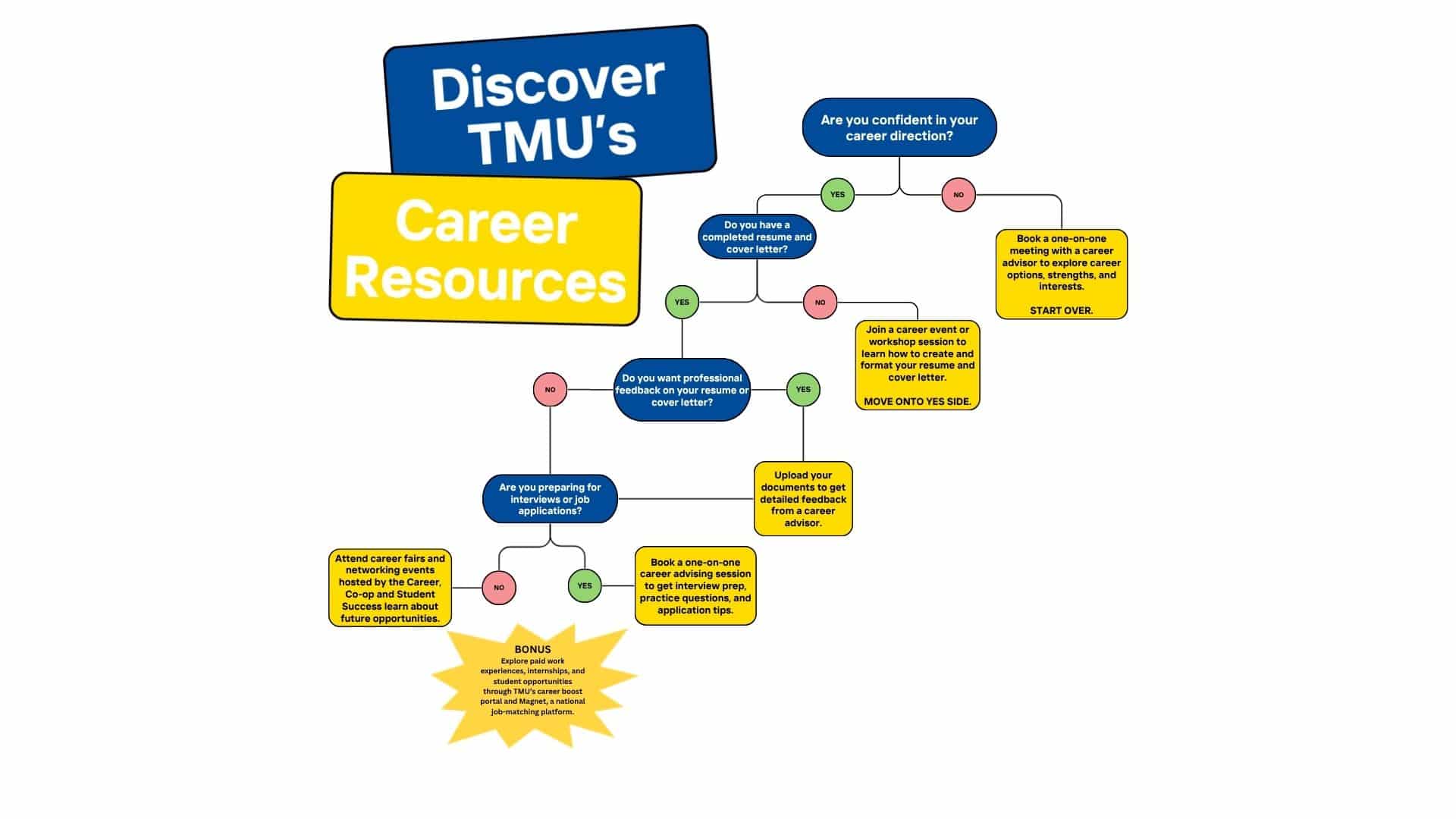
Use this decision map to guide your exploration of TMU’s career resources and to find which support programs best fit your career needs.
Aside from one-to-one appointments, TMU offers several programs that help students bridge the gap between academics and work.
One of them is the Career Boost program, which offers TMU graduate and undergraduate students paid full-time and part-time positions on campus during the academic year. The program helps students build networks within the university and develop tangible skills.
“A lot of students don’t [know about Career Boost], so every year there are at least a hundred jobs that don’t get filled because they don’t get enough applications,” said Bin-Soekardji.
These positions include a wide range of fields, including research, administrative, and creative work. All of these positions are listed on the career boost website, but Bin-Soekardji pointed out that there are “a lot more steps involved in accessing them” compared to external sites such as LinkedIn or Indeed.
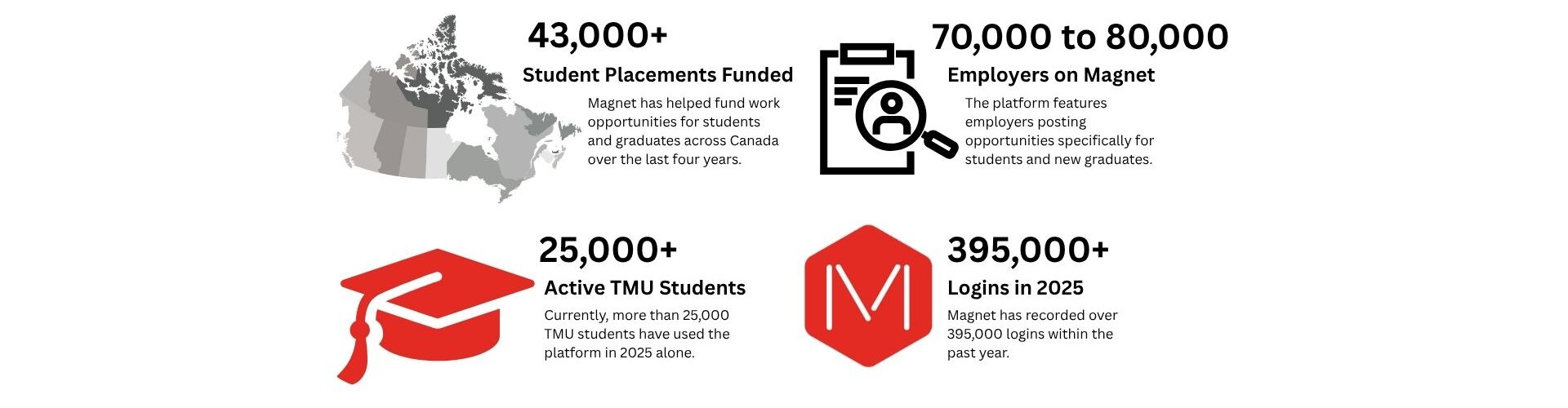
Another resource available to graduates and undergraduates is Magnet, a national employment and labour market platform housed at TMU that connects students and job seekers across Canada. Students have access to a blend of internships, permanent, contract, freelance, part-time, and seasonal jobs.
Mark Patterson, executive director of Magnet, says that the organization provides funding to help employers hire students. This is especially important during times of ongoing economic uncertainty. Patterson explains that recent tariffs and broader economic challenges have led businesses to pause growth, investment, and hiring.
“One of the challenges when you have that kind of cooling in the economy [is that] new grads or people just starting out in their careers tend to be disproportionately impacted at times like that,” Patterson said.
Here is how Magnet has been able to alleviate some of those challenges.
Another way TMU is helping students prepare for work is through a program led by the university’s Diversity Institute (DI) called Advanced Digital and Professional Training (ADaPT). While the program was developed at TMU, its main focus is to serve participants across Canada.
The program works closely with employers and industry associations to identify emerging skill demands. It also implements employer feedback into curriculum design, ensuring participants are trained to reflect real-world needs in fast-changing sectors such as technology, digital marketing, and professional services.
Although the main ADaPT program has ended, several of its extensions are still active, including ADaPT for Black Youth in Ontario and Newcomer Employment & Entrepreneurship Skills Hub.
ADaPT for Black Youth in Ontario is an extension of ADaPT. It is a cohort-based skills development and work placement program that is designed to prepare Black youth for jobs through training in professional skills, digital literacy, and communications.
In ADaPT’s 2024-2025 report, one participant described their experience as “a great fit for the skills I wanted to develop and provided me the opportunity to explore areas I was not familiar with” and said that the program was “a fantastic opportunity to hear from Black professionals in various disciplines, highlighting the importance of representation for members of underrepresented communities.”
Newcomer Employment & Entrepreneurship Skills Hub (NEESH) is a trauma-informed and culturally sensitive stream designed to specifically meet the needs of newcomers. It offers a six-week program that combines professional skills, job-readiness, and entrepreneurship training in finance, procurement, and social media.
ADaPT designed the program based on research from DI, Environics, and the Future Skills Centre, which revealed that nearly 60% of recent immigrants and young Canadians wanted to start their own business. This is because, according to them, many immigrants are pushed into entrepreneurship due to exclusion from traditional jobs and a desire for flexibility, which influenced NEESH’s emphasis on entrepreneurship training.
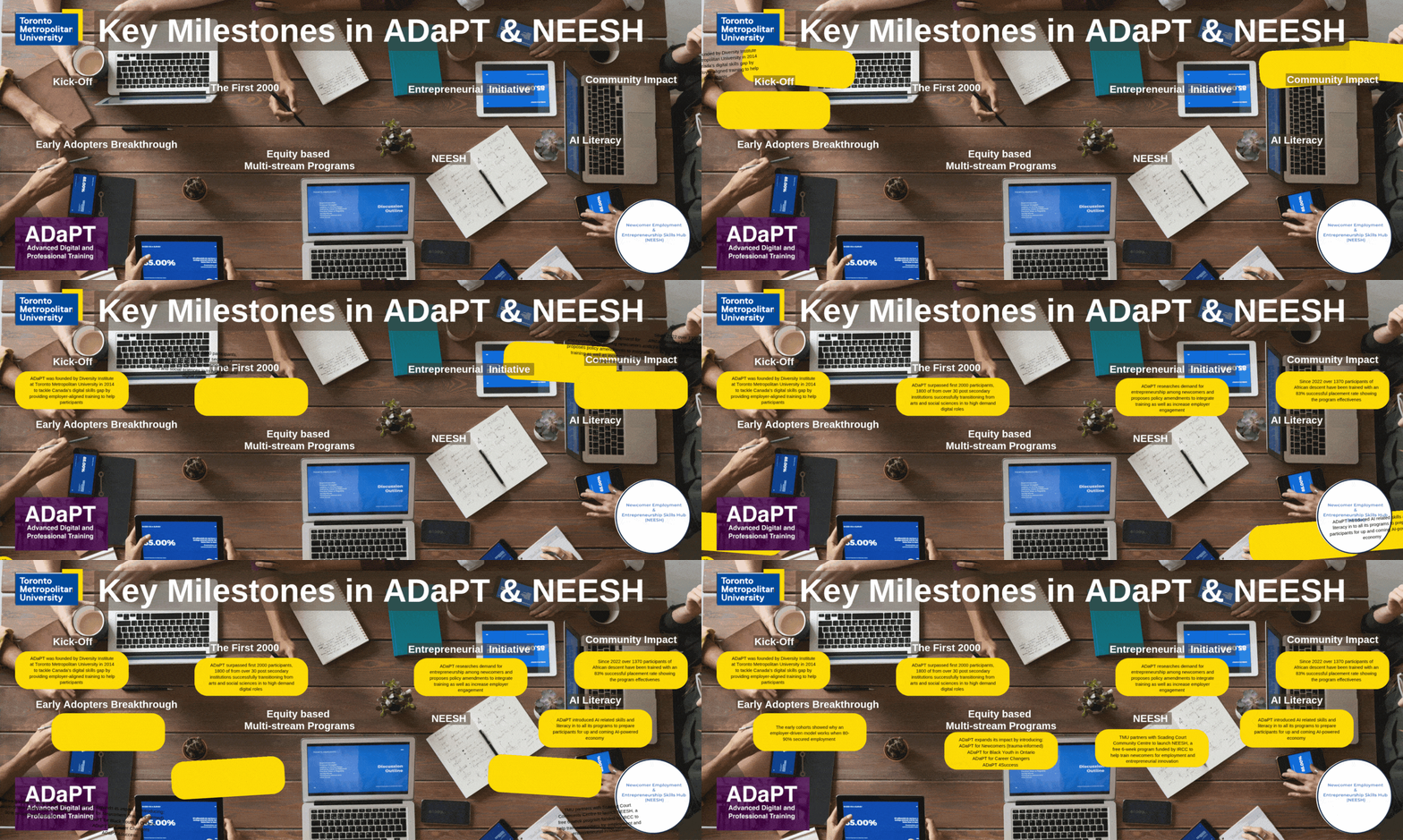
An overview of the key milestones that shaped the ADaPT and NEESH programs, from early breakthroughs to community impact and AI literacy. Graphic by Willa Jaggi.
Along with these programs, TMU is expanding opportunities for students to connect directly with employers through career fairs. The STEM career fair took place on Sept. 25, while the Creative Arts and Community Services Career Fair was held on Nov. 5.
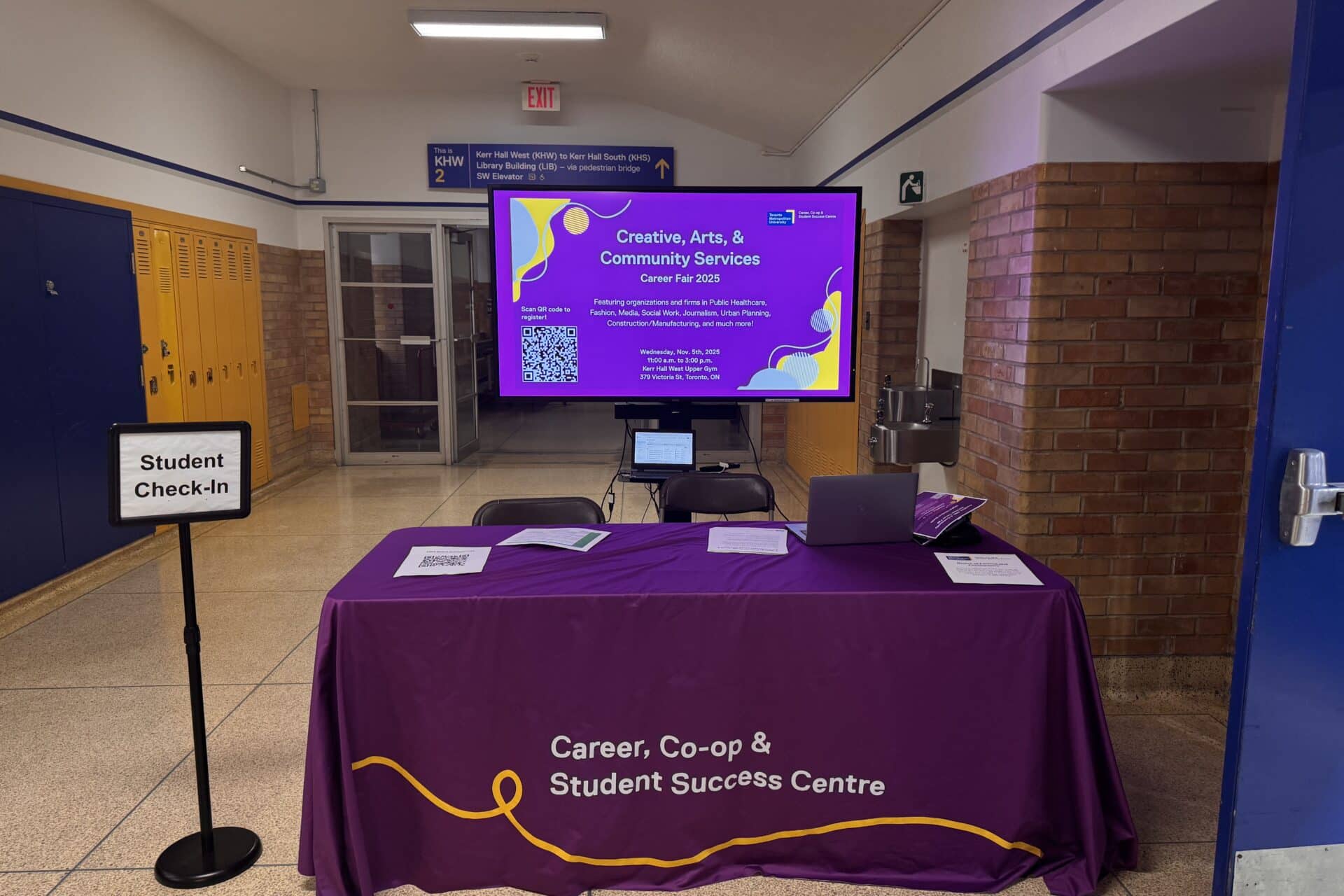
This is where students are required to check in before entering the Creative Arts and Community Services Career Fair, which started at 11 a.m. Photo by Julia Pen.
Before the Creative Arts and Community Services Career Fair, 50 students were given the opportunity to sign up for a pre-networking breakfast event. The event started at 10 a.m. and allowed students and professionals to make meaningful connections in a more relaxed environment.

As participants settled in with their breakfast and introduced themselves to the people around them, organizers explained how the session would run. Each round of discussions lasted ten minutes, giving students the chance to connect with new professionals after each rotation.

Eufemae Menendez is a fourth-year photography student at TMU who attended the pre-networking event and career fair. She said that the pre-networking event gave her an advantage to speak with professionals in a more intimate setting.
“I took that as an advantage to talk to all of these employers because once the career fair starts, they are talking to a bunch of students and sometimes they could get tired,” Menendez said.
Menendez added that the career fair helped her see new possibilities beyond her creative background. After meeting Michel Foucault, an associate in operations at TD Insurance, she learned that her administrative and marketing skills could also be applied to fields such as insurance and human resources.
“It almost felt like I was recognized in something and that really stood out with me,” she said.

Theresa Duerr-Farrell is another fourth-year photography student at TMU. She had never visited a career fair before and was relieved that staff from the Career, Co-op, and Student Success Centre were there to walk her through the process and offer advice on approaching employers.
While Duerr-Farrell appreciated the career fair overall, she noted that most opportunities catered towards community service and healthcare students, leaving fewer options for students in the Creative School program.
“I think there were like three opportunities out of the amount of booths, but I also understand that it’s a big university and there’s lots of programs that they need to attend to,” she said. “If they have the means to make it bigger, I think they should and invite more jobs or employers so there’s more options,” she added.
Li notes that the Career, Co-op, and Student Success Centre always welcomes students to share feedback about its services. After every workshop or event, students can complete post-evaluation surveys that help staff determine what can be improved.
“If students are telling us that they want to hear more about a particular topic, we try to incorporate that into future programming,” she said.
Li also says that the centre is working to keep up the pace with changes happening in today’s workforce, specifically the use of artificial intelligence.
“We’re all just trying our best to keep up with all the trends and just learn more about them,” she said.